Discover how to peak bag in the Cheviot Hills. Explore key summits, route ideas and tips for linking multiple peaks in Northumberland.
.avif)
If you’re looking for somewhere to link multiple summits without crowds, the Cheviot Hills are hard to beat.
This is a different kind of peak bagging. No queues, no obvious routes, and no single “main” mountain pulling everyone in. Just rolling hills, wide ridges, and the freedom to build your own day.
It’s less about ticking off famous peaks—and more about how you connect them.
Peak bagging is simple:
In the Cheviots, it works particularly well because the terrain naturally flows from one summit to the next.
Rounded hills and ridges make it easy to link peaks.
Even on weekends, you’ll likely have plenty of space.
You’re often a long way from roads and busy routes.
No fixed path—you can build your own combinations.
Height: 815m
Time (as part of route): 5–7 hours
Difficulty: Moderate
The highest point in the range—and a natural centrepiece for any route.
Broad summit plateau (wide, flat high ground) with peat and grassy terrain.
Height: 714m
Time (as part of route): 4–6 hours
Difficulty: Moderate
One of the more rugged peaks in the range.
Steeper slopes and rougher ground compared to surrounding hills.
Height: 619m
Time (as part of route): 4–6 hours
Difficulty: Moderate
Sits right on the England–Scotland border, adding a unique feel to the walk.
Rolling ridges with steady gradients.
Height: 777m
Time (as part of route): 5–7 hours
Difficulty: Moderate
A quieter summit with wide views across the range.
Open, grassy terrain with some boggy sections.
Height: 610m
Time (as part of route): 4–6 hours
Difficulty: Moderate
A ridge rather than a single summit—perfect for linking routes.
Open ridge walking with wide views.
Height: 652m
Time (as part of route): 4–6 hours
Difficulty: Moderate
One of the quieter peaks that helps extend a multi-summit day.
Rolling hills with grassy and occasionally boggy ground.
Peaks: The Cheviot + Hedgehope Hill
Time: 6–8 hours
Difficulty: Moderate–Challenging
A solid introduction to the range, combining the highest peak with one of the most rugged.
Peaks: Windy Gyle + Bloodybush Edge + Cairn Hill
Time: 5–7 hours
Difficulty: Moderate
Follows the England–Scotland border with continuous ridge walking and wide views.
Peaks: 4–6 summits combined
Time: 7–10 hours
Difficulty: Challenging
For those looking to cover serious ground and link multiple peaks in one go.
Follow ridges and high ground to connect summits.
The terrain looks easy—but distances add up.
Always have a way to shorten your route if needed.
Peak bagging in the Cheviots is ideal if you:
It’s less structured—but that’s the appeal.
Paths can fade or disappear completely.
Peat and wet terrain are common.
These hills are exposed and conditions change quickly.
Plan properly—it’s still a full mountain day.
Peak bagging in the Cheviot Hills isn’t about ticking off famous summits.
It’s about linking landscapes, building your own routes, and experiencing a quieter side of UK hiking that feels a bit more like an adventure.
Track your hikes, log your summits, and build your peak list with Peaky Baggers.
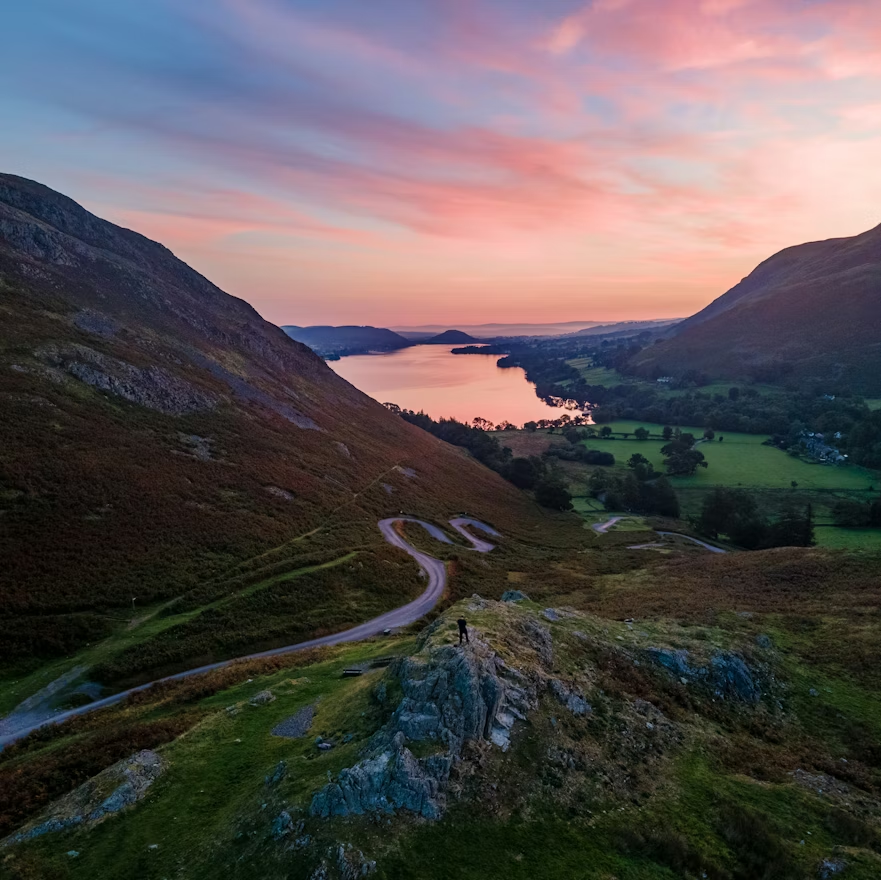
Photo by Craig Birch on Unsplash